Day 1 - Breathing
A gateway we can always access

If you only have a few seconds
Breathe with this:
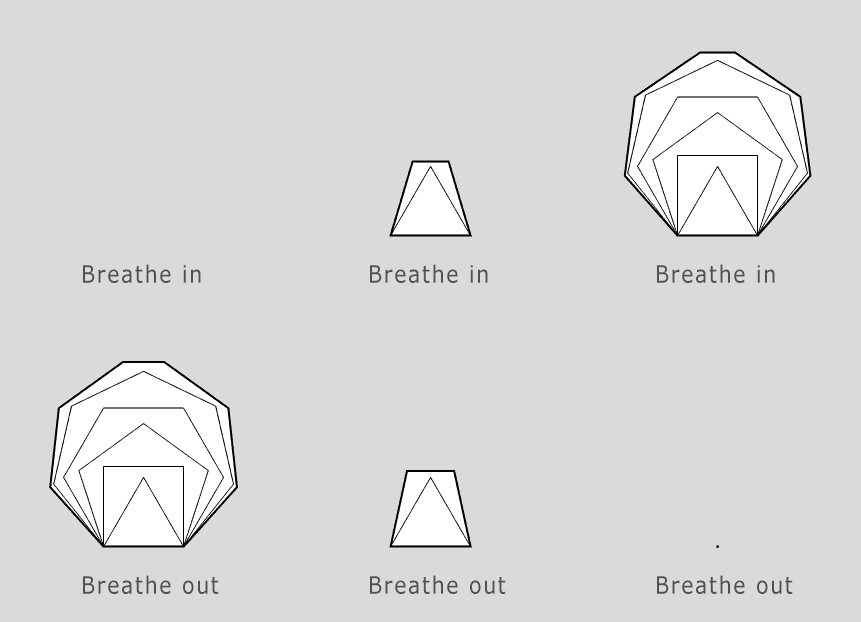
Shape and pacing
This simple image of an expanding polygon shows two things that people often benefit from when breathing:
Slowing down, with a pause after each phase
Expanding volume, forward and out
This last point is most apparent when thinking of the polygon as our ribcage, expanding towards the front and the sides.
Youtube has many videos that show how ample, expansive breathing works in our body, with visualizations of the lungs and diaphragm:
This brings us to what we are doing when we are not breathing this way.
Types of breathing
A 2-minute video that shows how most people breathe, “up and vertical,” and a different way to breathe by expanding all around the body:
Many professionals lump together diaphragmatic and belly breathing, for example this page of the Cleveland clinic states that “Diaphragmatic breathing is also known as: Abdominal breathing. Belly breathing.” This can all get a little confusing, but it doesn’t have to be: it all depends how “far” you zoom out and how precise you want to get. When they are compared to shallow, upper shoulder breathing, diaphragmatic breathing and abdominal breathing have a lot in common and only minute differences, and both can usefully ground your body into a calmer state. For most of us, that’s enough. If you would still like to dive deeper into the finer distinctions of the many types of breathing, the end notes have pointers to a book that goes into much more detail.
Why practice breathing?
Our bodies are capable of functioning in a wide range of circumstances. We can run away from a tiger (a fight-or-flight response), or curl up next to a fire with a good book.
Our autonomous nervous system accommodates this by adjusting the functioning of our organs according to circumstances, regulating bodily functions that are largely involuntary.
In our stressful world, the balance between the system that primarily supports fight or flight high-stress responses (the sympathetic system) and the system that favors healing and regeneration (the parasympathetic system) is often tilted too much in favor of the sympathetic system. Breathing is one of the best handles we have to correct that balance, as we do have voluntary control over it. No type of breathing is “purely bad” or “purely good”, and similarly, no part of our autonomous system is bad (it’s good to be able to run away from a tiger) — rather, we modern humans tend to be too tilted towards chronic fight-or-flight, and playing with breathing is a powerful way to adjust that balance when we need.
Indeed, the research literature provides a lot of solid evidence on the positive effect of deliberate breathing and how it shifts us towards the parasympathetic system. Here are two examples, but there are countless more:
This 2017 article reviewing the physiological effects of slow breathing (4-10 breaths / minute instead of the typical 10-20) cites increased exercise performance, better return of blood through the veins, higher heart-rate variability (which is correlated with better health), and lower blood pressure, as consequences of slower breathing. It documents how slowing breathing shifts the balance towards the “rest and digest” parasympathetic system.
This 2015 article looks at the evidence of self-regulated breathing as part of treatment of anxiety. It discusses how slow breathing inhibits the sympathetic (fight or flight, escape the imaginary tiger) system.
Learning new body patterns, like slow, diaphragmatic breathing, takes time — and if you find yourself in a situation where you could benefit from slower, deeper, more expansive breathing, it will be much more available to you if you have already put in the time practicing and teaching your body how to do it.
Breathing practice and cues
Movement and body awareness practitioners often use specific cues to favor a specific type of breathing, for example visualizing ribs as the handles of a bucket rising up and down, while the sternum moves like a pump handle.
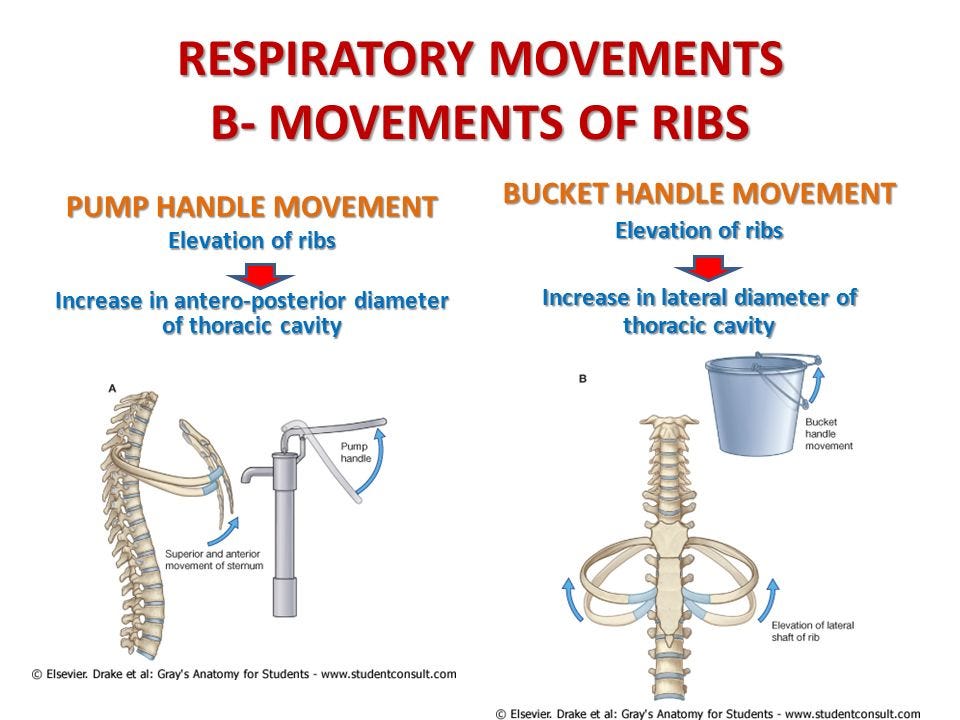
You can find more explanations and 3d videos and illustrations of the pump and bucket handles on this page from the Michigan State University.
Here’s a video if you’d like to practice abdominal breathing while lying down:
You’re actually not filling your belly with breath as the video says (the air remains in the lungs!), but it is a convenient image — the diaphragm in that style of breathing pushes the organs down into the belly so that the belly expands, and it feels as if air was going in there even though it’s only the organs being displaced.
You can also use a song to pace your breathing, like the Breathing in Breathing out song from Thich Nhat Hanh’s Plum Village:
If you’d like to target a specific rhythm (for example, 4 breaths / minute), there are also videos that you can follow to guide your breathing, where you breathe in with the rising notes, and breathe out when the notes descend.
4 breaths / minute
6 breaths / minute
A whole range of pacers on this page, from 4.5 to 8 per minute. Experiment and see what works for you.
Other ways to use the body to calm the mind
When we are tense or agitated, this often manifests in our bodies, for example with excessive tone in the shoulders and neck, or in a posture that is very compressed.
Here again, this is often a two-way relationship, and acting on the physical manifestations of our mental state can help improve how we feel. Besides, using our body and muscles better leads to fewer mobility restrictions: if we maintain chronic muscle tension, our bodies will help support that tension by creating more rigid connective tissue to keep it where we seem to want it (e.g. by reinforcing fascia), which in turns makes it even easier to keep that tension.
There is a lot more to say on this topic and this could be a mini-course on its own, so here are just a few quick pointers on other ways to calm the body:
Progressive muscle relaxation:
video instruction:
Pure release relaxation:
Video instruction:
Self massage:
Shoulders / neck
Foot:
Scalp:
For a longer-term, deeper investment in body awareness practice and how what we think influences how we hold ourselves, I highly recommend the Alexander technique. Body Learning by Michael Gelb is a very good introduction.
Practice twice a day!
That’s it for today — I hope you find enjoyment in the practice of various ways of breathing and being in your body. It takes some time to truly experiment with all, so I will wait a few days before sending Day 2 of the mini-course. Try and practice breathing exercises or slow-breathing twice a day for the next 5 days!
There are a few additional links, notes and pointers below. If you’d like to hear more about some parts of this post, let me know and I will consider it for a future post or part of another free mini-course. And of course, I am always happy to hear any feedback on what you liked / didn’t like / things you’d like to see more or less of. I can’t reply to most emails but I read them all and they are always welcome.
Additional links and notes
I often send the polygon breathing GIF to friends in Messenger or other texting services that allow the inclusion of gifs, where I can often find it by searching “breathing triangle” or breathing polygon or triangle breathing… depending on the days.
I first saw it in a conversation with Woebot. But, what is Woebot? It’s a conversational tool that teaches useful skills and checks in with you. I haven’t tried it in a while but when I did, it had a lot of thoughtful, well-motivated content. So if you’d like to give it a try, I believe it’s still free. If you enjoy this conversational format, another well-regarded chatbot that teaches some wellness skills within a free version is Wysa.
If you prefer a video format to add to a wellness youtube playlist: here’s a one-minute video version of the breathing gif:
Other gifs that help breathe slower and wider, in case you prefer other styles
Calm breathing sheet on Anxiety Canada
There are other well-known forms of structured breathing that play with timing, for example:
Square breathing, also with a page on the benefits of deep breathing
Types of breathing: If you’re interested in completely sorting out the distinctions, Blandine Calais-Germain has a great book on the anatomy of breathing. In particular, while discussing the two main types of breathing (costal and diaphragmatic), she emphasizes that none of the variations of breathing is the only good one, or always a bad one: it all depends on circumstances. Chapter 8 of the book breaks down the more specific types of breathing, distinguishing diaphragmatic breathing that primarily involves movement towards the belly (belly going out) vs. movement of the ribs (bucket handle), with their advantages (e.g., most efficient way of achieving maximum ventilation for minimal effort, maintaining relaxation in rib and shoulder area) and disadvantages (e.g., not mobilizing the rib cage very much, which can lead to rigidity). It also goes over the advantages of costal breathing (increasing muscle tone and energy) and its disadvantages (possibly contributing to tension and stress from that constantly increased muscle tone). Her book also has an extensive section of exercises to learn fine control of breathing.